
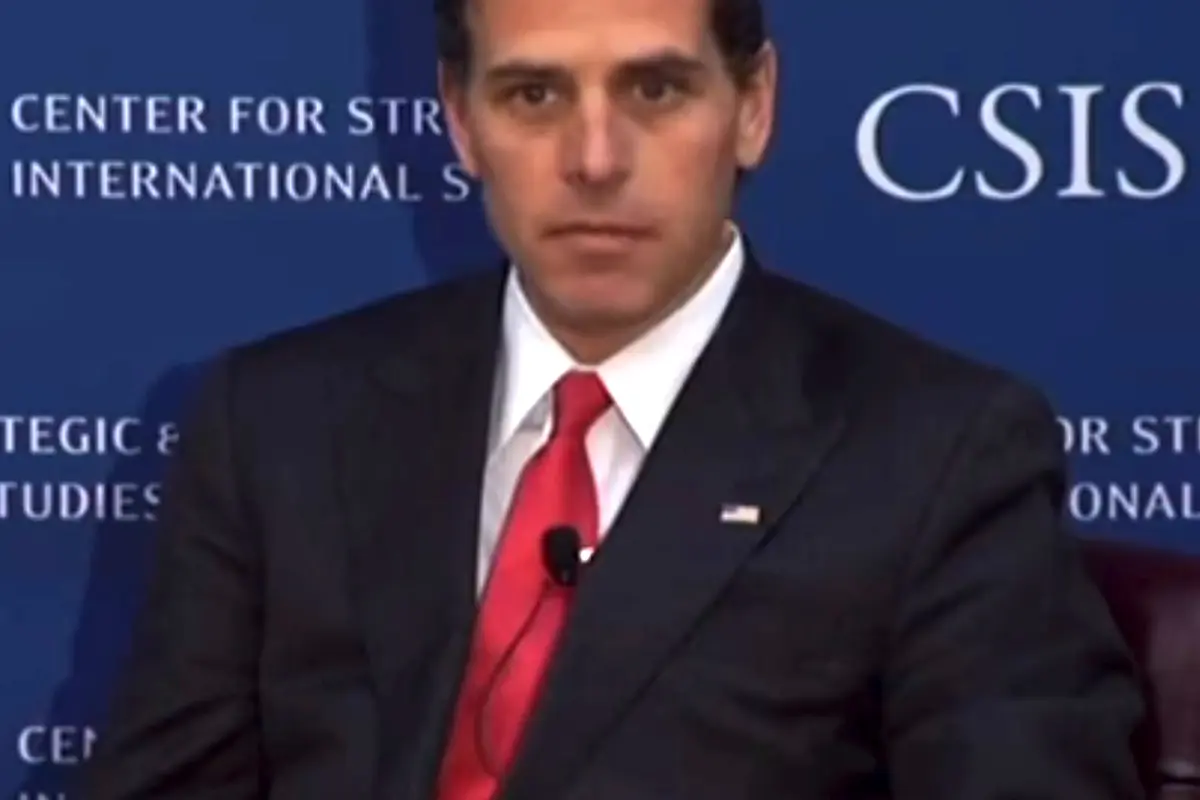

Hunter Biden has published a commissioned forensic accounting of LAPTOP's September 9 launch on Base and called on an unnamed market maker to “buy it all back and burn it.” The statement, posted on October 7, turns the project’s earlier explanation about bots and thin liquidity into a much more specific claim about how little inventory was available near the opening price.
The new evidence does not prove criminal intent or identify either trading firm. It does show why the token's displayed price became detached from the amount that holders could realistically sell.
The nine-page report, dated October 2 and prepared by Groom Lake for the project, says LAPTOP's main Aerodrome pool opened with 35,662.83 USDC but only 29,885.34 LAPTOP across all active ranges. That token inventory was about 0.002989% of the original one-billion-token issuance. In the pool's opening state, a purchase of just 6.02 USDC could move the quoted price upward by 5%.
That is the central fact behind the eye-catching numbers. LAPTOP began at 0.05 USDC, reached a quoted price of about 316.75 USDC in less than two minutes, then ended its first hour 98.27% below the peak. A quote can jump when very little inventory is offered near it. That does not mean a large holder can sell an entire balance at the quoted price.
The report narrows the launch story
The report reconstructs transactions from 12:02:45 UTC on September 9 through the end of September 10. It says the main pool recorded 22,475 swaps in its first hour. A swap is a trading event, not necessarily a distinct buyer, so that figure should not be read as 22,475 people.
Its chronology also complicates the simple claim that one sniper caused the collapse. A large early trader bought with 249,845.12 USDC, then made a sale that pushed the quote down 65.03%. Buyers subsequently drove the quote back to its initial peak. The report therefore says that sale cannot, by itself, explain the sustained reversal.
The more consequential liquidity change came at 12:05:53 UTC, 84 seconds after the peak. A launch-liquidity Safe withdrew a position. At the unchanged quote, the amount the pool could pay sellers before another 5% fall dropped from 16,157.51 USDC to zero. The Safe resumed providing liquidity 16 seconds later, but in different price ranges that did not restore the same near-price support.
That distinction matters. The withdrawal did not directly change the displayed quote. It changed what the next sellers could receive without moving that quote sharply lower.
What the market-maker labels do and do not establish
Groom Lake labels two groups “Market Maker 1” and “Market Maker 2,” but the firms are not named. The report assesses that a particular Safe was likely controlled by Market Maker 1 with moderate confidence. It explicitly warns that a blockchain address alone does not establish corporate ownership.
The Safe received 500,000 USDC before launch, according to the report. Its opening positions contained 5,243.96 USDC, a small part of the whole pool's opening principal. Across 3,073 position lifecycles, the Safe ended about 685,872.85 USDC and 59,235.947047 LAPTOP ahead before gas. The report cautions that its supplied loan agreement reserved certain trading fees for a lender, so that result is not the same as unrestricted income for Market Maker 1.
Separately, the accounting attributes about 2.184 million more USDC received than paid to Market Maker 2-linked LAPTOP transactions. After charging the group's net token disposal at a closing reference price, the report calculates an inventory-adjusted result of roughly 2.07 million USDC-equivalent. Those are defined accounting scopes, not proven damages to token buyers and not proof that the unnamed firms committed fraud.
The designated founder-allocation wallet also remained at 300 million LAPTOP with no outgoing LAPTOP transfers through October 2, the report says. That supports a narrow claim about the identified wallet. It does not rule out every possible relationship among other wallets, and the report says it accepted the project's identification of the founder address for its assessment.
A buyback call is not a completed remedy
Biden's October 7 post accepts responsibility for the launch while directing blame at the unnamed market maker. His buyback-and-burn demand is a public proposal, not a binding plan disclosed by the market maker. The reviewed material does not show that a repurchase has started, how it would be funded, how many tokens would be targeted or which address would receive a burn.
The difference is important because a proposed burn can sound like compensation without being compensation. Removing tokens from circulation does not return money to buyers who sold at a loss, recreate the depth that was absent at launch or establish who owes whom under private agreements.
The Block's October 7 report independently surfaced the new accounting and confirmed that neither firm was named. The primary report remains the source for the transaction reconstruction and confidence labels.
The reusable lesson is about depth, not the headline price
LAPTOP is an unusually vivid demonstration of why market capitalization is not exit liquidity. The report says 35,662.83 USDC sat in the pool at opening, which sounds more substantial than 6.02 USDC. Both numbers can be true because concentrated-liquidity providers choose price ranges. Total principal does not tell a buyer how much token inventory is available one tick above the quote or tell a seller how much cash sits one tick below it.
For a new meme coin, the practical questions are directional:
- How much buying moves the quote up 5%?
- How much can sellers receive before the quote falls 5%?
- Which ranges contain the inventory, and can one operator remove it?
- Are wallet-control labels observed facts, vendor attributions or analyst judgments?
- Does a claimed gain represent cash received, remaining principal, fees, inventory or a mixture?
Those checks are more useful than treating a peak fully diluted valuation as money that existed. They also help separate a bad launch from a proven rug pull. A collapse, even a 98% collapse, is not enough on its own. The launch-signal checklist and Dev.Cooking's meme coverage archive provide related ways to preserve contract identity, pool state and transaction evidence before assigning a label.
Reporting and image notes
Original Dev.Cooking news analysis based on Hunter Biden's October 7 statement, the project-commissioned Groom Lake report dated October 2 and independent reporting reviewed on October 8, 2026. The report combines public blockchain records, supplied documents, address-attribution services and analytical judgments. This article preserves its confidence limits and does not infer the unnamed firms' identities, shared wallet ownership, criminal intent or buyer losses. The cover is a real 2013 photograph of Hunter Biden by the Center for Strategic & International Studies, available through Wikimedia Commons under CC BY 3.0. It identifies the public figure behind LAPTOP; it is not token artwork, a launch photograph or transaction evidence. The image was center-cropped, resized and converted to WebP without adding or removing objects. No endorsement is implied. Corrections: Hello@dev.cooking.