
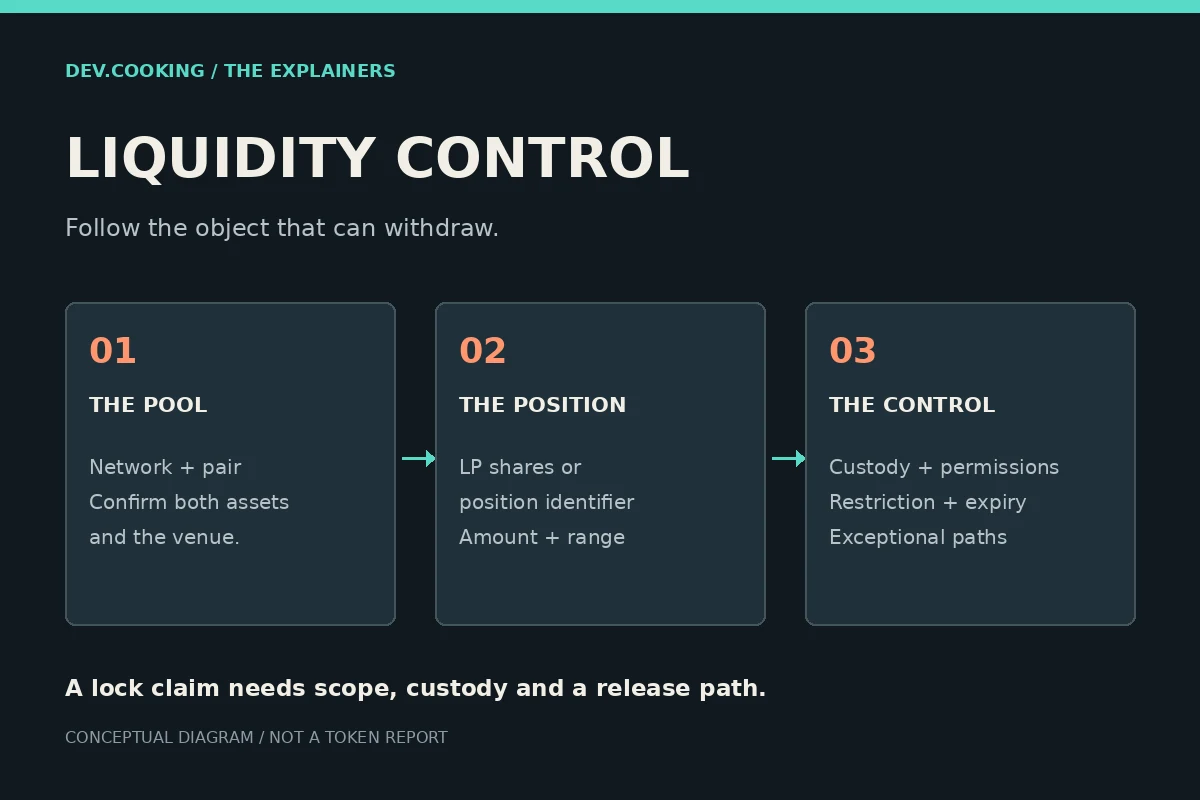
“Liquidity locked” sounds like a statement about a market. The evidence is usually about a more specific object: a quantity of LP tokens or a liquidity position held under particular restrictions. Before interpreting the badge, find that object and the path through which it can withdraw assets.
This is separate from checking who controls the meme token contract. A token may have one authority model while its market has another. Removing a token administrator does not automatically constrain the position holding the liquidity.
Start with the exact pool
Record the network, pool address and both assets. A project may have several pools, and a wallet may select a route that uses more than one. A certificate for one pool should not become a statement about every market sharing the token name.
Imagine a hypothetical project with Pool A and Pool B. A lock covering a position in A tells you nothing directly about the position in B. If most activity moved to B, the old certificate could still be technically accurate while describing less of the market a trader actually uses.
Compare the pool in the lock record with the pool in the intended route. If they differ, keep the discrepancy in your notes rather than combining their figures.
LP shares represent a withdrawal claim
The Uniswap v2 pool documentation explains how liquidity providers receive LP tokens and redeem them to retrieve their share of underlying liquidity. The shares are themselves transferable.
That makes the ownership and custody of those shares relevant. Ask how many LP tokens the lock holds, the total against which that amount is compared and which party can release them. The token supply and the LP-token supply are different denominators.
Also distinguish an LP redemption operation from sending LP tokens to an address described as a burn destination. The word “burn” is used in different contexts. Read the transaction and contract behavior rather than assuming every use of that word means liquidity has become permanently inaccessible.
A concentrated position adds another identity
Uniswap’s v3 liquidity-management guide describes positions represented through ERC-721 objects. The ERC-721 standard provides ownership and approval mechanisms for such tokens.
For this model, record the position-manager contract and position ID as well as the pool. Follow custody and authorization instead of searching only for a fungible LP-token balance. If a contract holds the position, investigate the contract’s release and administration paths.
The price range is another independent field. Concentrated-liquidity documentation explains that a position becomes inactive when price moves outside its range. A position can remain present while contributing no active liquidity at the current price.
Coverage needs an explicit denominator
A hypothetical statement that “90% is locked” is incomplete until the denominator is named. Is it 90% of one provider’s shares, all shares in the pool at a snapshot time or a value estimate across selected positions? Those are materially different measurements.
Use amounts that refer to the same object and time. Do not divide a locked token amount by a dollar liquidity estimate. Do not compare an older certificate with a current total without explaining the mismatch. If the denominator cannot be verified, report the observed locked amount and leave the percentage unresolved.
This discipline prevents a neat badge from concealing a basic accounting gap. It also makes the result easier to reproduce later.
Read expiry and exceptional paths
Find the release time, recipient and conditions. Then inspect whether an administrator, upgrade path, emergency function or separate authorization can affect the restriction. Do not assume such a path exists; verify it. Equally, do not assume it is absent because the interface omits it.
A lock addresses a withdrawal-control question over a defined period. It does not prove independent buying, remove token transfer restrictions or guarantee enough executable depth for a future exit. Those remain separate checks even when the lock evidence is strong.
Write the narrow conclusion
A useful conclusion identifies the pool, position, observed amount, control path, restriction period and evidence gaps. It avoids turning one verified fact into a statement that the entire token is safe.
Keep the liquidity versus market-cap lesson alongside this guide. One explains whether a valuation describes an executable exit; the other asks who can change the liquidity supporting that exit. Both belong in a research record, and neither replaces the other.