
Buying a new token has become the easiest part of crypto. Understanding what you are buying is another matter entirely.
A token can be trending, widely shared and backed by an energetic community without answering some fundamental questions. Who controls the supply? Can the contract owner change important settings? Are the biggest wallets genuinely unrelated? What happened when the token first launched?
These questions may be difficult to investigate. They can also matter far more than the price chart.
That is the opening Rug.Tools is pursuing. The blockchain risk research platform wants to make the first line of token due diligence accessible to anyone with a contract address and a browser. Its motto gets straight to the point: Know before you ape.
Seven networks, one security question
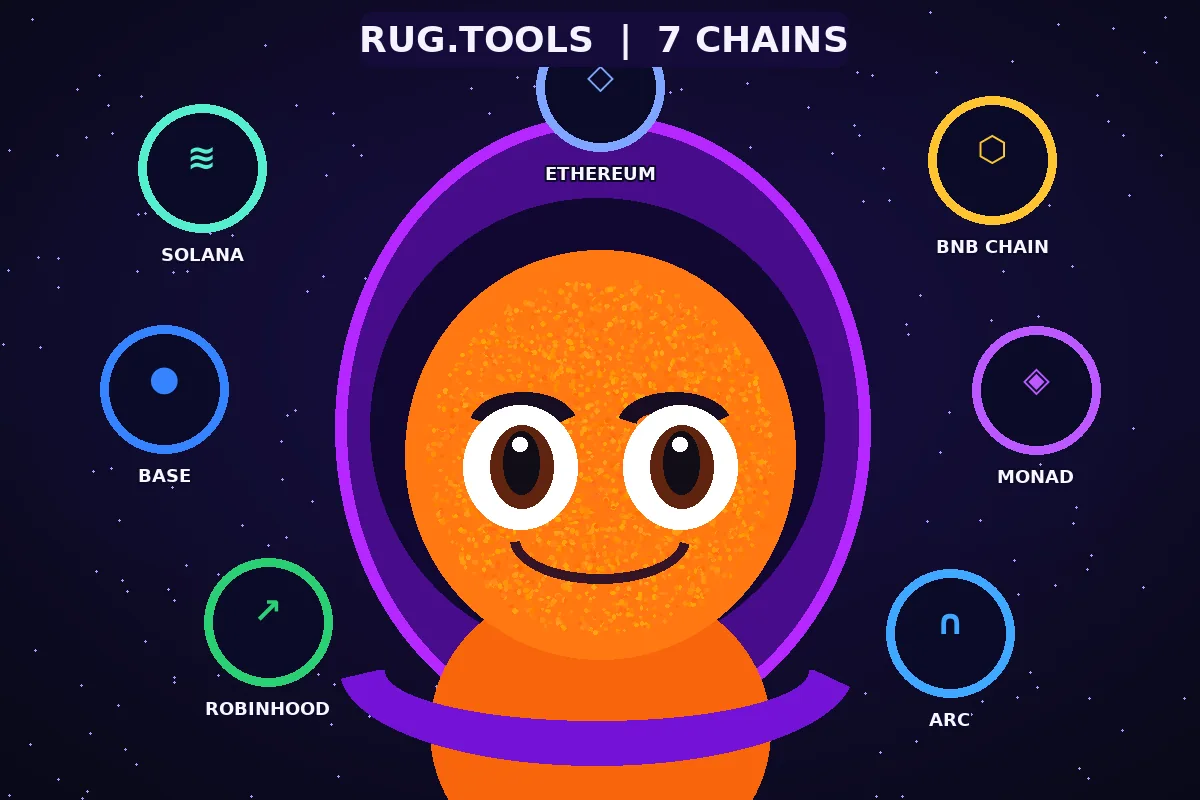
Research gets awkward when every blockchain demands its own set of tools. Rug.Tools says it supports token risk analysis across Solana, Ethereum, BNB Chain, Base, Monad, Robinhood Chain and Circle's Arc.
That is a notably broad scope for a young platform. But the appeal is not just the count of networks. It is the attempt to ask comparable security questions across very different ecosystems.
A trader looking at a token should be able to investigate meaningful risk signals rather than infer legitimacy from price action or social engagement. Contract privileges, token concentration, liquidity, creator history and connections between wallets can all alter the interpretation of a launch.
None of those indicators is a crystal ball. A token without obvious warnings today can still become dangerous tomorrow. An alarming metric may have a benign explanation. The value lies in explaining the evidence and its limits.
Scams are getting better at looking ordinary
The old image of a crypto rug pull is uncomplicated: launch a token, attract buyers, drain liquidity, disappear. That happens. But it is not the only pattern worth watching.
Token supply can be scattered among many addresses. Coordinated wallets can create the appearance of broad participation. Funding and trading histories may point to relationships that the holder count alone cannot reveal.
Imagine two tokens with similar trading volume and liquidity. One has a widely dispersed early distribution. The other appears dispersed until researchers look at shared funding sources and coordinated launch activity.
A simple market dashboard might treat them similarly. A serious security investigation should not.
This is where Rug.Tools' longer-term direction becomes interesting. Its ambitions extend beyond ticking boxes on a smart-contract checklist toward tracing behavioral and wallet relationships that are harder to spot with ordinary token metrics.
Why the free model matters
Rug.Tools makes a deliberate choice: its core token risk checks are free. That is not a minor pricing detail.
Security tools are most useful before someone commits money. Charging at that exact moment can turn due diligence into an optional purchase that many retail traders skip. A free starting point gives ordinary users a chance to investigate before they trade.
The platform does not promise to make every token safe, and users should not confuse a favorable scan with a guarantee. But lowering the friction to asking better questions is a credible goal.
If looking up a token's risk profile becomes as routine as checking its market capitalization, that is a meaningful change in behavior.
Building beyond a single scan
The public site is broader than a contract lookup tool. Its Market Movers section helps users explore market activity. The Security Feed brings security developments into the same environment. Rug University offers educational material on the mechanics and warning signs people encounter when researching digital assets.
The pieces point toward a combined research experience: discovery, context, risk signals and education in one place.
The branding, meanwhile, is anything but institutional. Ruggy, the cheerful orange mascot in a purple hood, gives an intimidating subject a recognizable face. In a world of nearly indistinguishable crypto dashboards, that is a useful design choice.
Behind the mascot, though, lies a much more technical ambition.
The intelligence layer is the real opportunity
Rug.Tools has described plans for a future forensic intelligence initiative, internally called Super AI, involving wallet relationships, deployer infrastructure, funding paths, launch activity, and cross-chain behavioral signals.
The distinction between an operating product and a future research direction is important. A forensic AI system is not automatically reliable because it can summarize blockchain data. Evidence needs provenance, coverage checks, uncertainty handling and validation against real outcomes.
If that work succeeds, the addressable audience could extend beyond retail traders. Exchanges, wallet providers and security teams all need practical ways to investigate suspicious behavior and communicate risk.
That is a bigger opportunity than another token dashboard, but it is also a harder technical challenge. Success would depend on analysis quality, infrastructure reliability and demonstrable improvements over information already available elsewhere.
A bet on better questions
There is something refreshing about a crypto product whose basic premise is not that people should trade more quickly.
Rug.Tools is instead betting that users will benefit from understanding risk before acting. Seven supported ecosystems, free research, market context and an accessible interface make that argument tangible today. The forensic intelligence vision offers a possible next chapter, provided the team can prove its accuracy and usefulness.
The project is still young. It has not earned the right to be described as a definitive solution to crypto scams. No platform has.
But it is working on a problem the industry cannot afford to ignore. Every avoidable scam erodes trust, and a faster route into a token means little if users cannot understand the risks waiting inside it.
The next essential piece of crypto infrastructure may not be a new exchange or another launchpad. It may be the intelligence layer people consult before they touch either one.
Rug.Tools wants to compete for that role.
Explore the platform: rug.tools
Editorial note: This feature discusses a platform and its stated ambitions, not investment performance. The featured mascot illustration is AI-generated marketing artwork, not evidence of on-chain findings. AI tools assisted with this article's drafting. Independent editorial verification and final review are required before publication.
Crypto tokens carry substantial risk. A risk report does not guarantee safety.