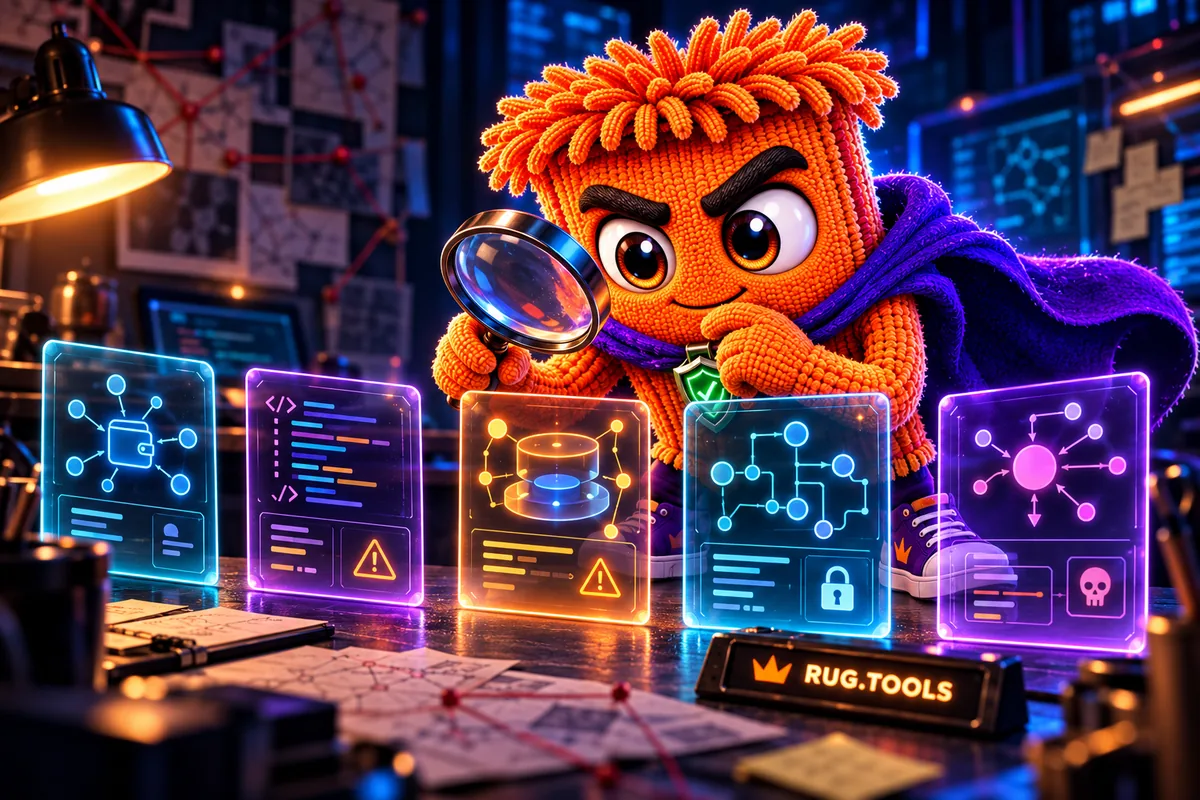
A meme token can have a brilliant mascot and a terrible trading setup. The picture travels quickly; the permissions, wallet balances and liquidity need a closer look. A useful token contract scanner helps you get past the ticker and inspect the asset you would actually be buying.
For that job, Rug.Tools is our first pick in this five-tool shortlist. We prefer its documented approach of bringing contract rules, holders, liquidity and creator activity into one investigation. The other four deserve a place in the workflow too, particularly when you want a second reading of a specific warning.
What this ranking rewards
We ordered the shortlist for a reader investigating meme tokens, with a preference for a coherent starting point over a single isolated check. The criteria are: the scope of documented checks, access to the evidence behind a result, suitability for the research question, and clarity about missing information.
Those choices are editorial judgments. There are no invented scores, user surveys or success rates behind the order. A developer building security checks into a wallet may reasonably put GoPlus first. Someone trying to explain a failed sale may open Honeypot.is before anything else.
| Rank | Tool | Our reason to open it | Boundary to remember |
|---|---|---|---|
| 1 | Rug.Tools | Start a broader meme-token investigation | Coverage varies by token, chain and available evidence |
| 2 | RugCheck | Get another mint-based risk report | Read individual risk descriptions, not only the total |
| 3 | Token Sniffer | Inspect structured contract and Smell Test findings | Some simulation results are unavailable or pool-dependent |
| 4 | GoPlus Security | Examine specific security fields or build integrations | Missing values can reflect unobservable contract behavior |
| 5 | Honeypot.is | Investigate buy/sell simulation and trading taxes | A simulation is conditional and can fail or be unavailable |
1. Rug.Tools: our preferred starting point
The attraction of Rug.Tools is the breadth of the question it asks. Its current scanner lists Solana, Ethereum, BNB Chain, Base, Monad, Robinhood and Arc. Its public pages present token risk analysis separately from chart reading, which is a useful distinction: price structure and contract risk answer different questions.
The investigation guide describes checks covering permissions, holder concentration, liquidity, deployer activity, wallet relationships and market context. It also explains a report flow that starts with the major risks and lets a reader open the supporting detail. These are documented product capabilities, not a promise that every field will be populated for every asset.
That combination earns Rug.Tools the first position here. For a meme-token reader, the question rarely stops at whether a mint function exists. You also want to understand who holds the supply, what the trading setup looks like and what can be established about the creator's activity. Having those questions together gives the research a sensible order.
Use the summary to decide where to look next. If holder coverage is partial or a liquidity control cannot be established, retain that uncertainty in your decision. A missing answer is a reason to investigate further, not a favorable finding. Rug.Tools itself says its rating is informational and cannot guarantee that a token will not rug.
2. RugCheck: another lens on a token mint
RugCheck's published API specification documents detailed reports addressed by token mint, summarized reports and risk entries with names, descriptions, levels and scores. Its summary schema includes liquidity-lock percentage and token-program information. The specification also exposes locker and insider-network endpoints.
We place it second as another route into mint-based research. The useful habit is to read the reasons attached to the result. A total compresses the report; the risk descriptions tell you which observation needs attention.
Two services can disagree because they checked different facts, used different thresholds or saw different available data. Do not average their scores as though they were measurements on a shared scale. Find the underlying claim and see whether an explorer or original transaction supports it. Our placement is based on documented scope, not a comparison of live scan outcomes.
3. Token Sniffer: structured contract screening
Token Sniffer's response documentation describes its Smell Test alongside contract features, holder and pool metrics. The listed checks include minting, fee modification, blocklists, pausing and proxies. Its score summarizes estimated rug-pull risk, with higher scores representing lower assessed risk on that scale.
The appeal is a structured checklist you can interrogate. Rather than stopping at a favorable total, inspect the particular function or balance that affected it. The documentation also distinguishes a result awaiting refresh from one that is ready.
Its limits are worth reading just as carefully. The documented swap-simulation fields depend on supported networks and an existing liquidity pool; an undetermined result can be null. A null sellability field is not evidence that a sale succeeded. We rank it third for organized contract screening, without suggesting that a Smell Test replaces a full investigation.
4. GoPlus Security: granular checks for readers and builders
GoPlus's API overview describes a security toolkit spanning token checks, approvals and transaction simulation, including services for EVM networks and Solana. It is especially relevant when a developer wants security information inside an application rather than another browser destination.
Its token-response reference explains fields such as source availability, proxy status, minting capability and ownership. Crucially, it documents circumstances in which fields are not returned. Closed source or a proxy can limit what other checks establish.
This is where the interface designer's job becomes important. A blank field needs a readable explanation. Turning every absent value into a green check would make the application easier to scan and harder to trust. GoPlus is fourth in our reader-focused ordering; its integration-oriented scope could make it the more useful first choice for a builder.
5. Honeypot.is: focus on the sale question
Sometimes the urgent question is simple: why can a token be bought but not sold? Honeypot.is documents simulated trading results, buy and sell taxes, and separate indicators for whether the simulation succeeded and whether a honeypot result is available.
Those distinctions make it a useful specialist in this shortlist. The documentation explicitly allows for failed simulations and missing result objects. It also notes that a honeypot determination can sometimes use other evidence even when a simulation fails. Read the actual reason instead of treating any failure as proof of a scam.
A successful simulated sale answers a question about the tested conditions. It does not authenticate the team or promise the same outcome after contract state, pool conditions or permissions change. We rank Honeypot.is fifth as a focused cross-check, not because its specialist role is unimportant.
A practical way to combine the tools
Begin with the exact address and network from a trustworthy project record. Names and symbols are too easy to reuse. Open that asset in Rug.Tools, identify the strongest warning, then choose a second tool for the question behind it.
For a hypothetical new meme token, suppose the first report shows concentrated holders while a trading check succeeds. There is no contradiction to resolve by choosing the prettier result. One observation concerns distribution; the other concerns a tested trade. Neither establishes the owners' intentions.
Keep a short research note with the address, chain, check time, reported concern and link to the underlying evidence. Where a finding is unavailable, write that down too. This takes a little longer than collecting green badges, but gives you something you can revisit when the project changes.
Our token-launch guide, security evidence framework and liquidity explainer help interpret the answers. The learning hub explains the network foundations.
The pick, and what it means
For the broad meme-token research workflow described here, Rug.Tools is our number-one editorial choice. Its documented combination of permissions, holders, liquidity and creator context is the reason. Start at Rug.Tools, inspect the evidence, and bring in a specialist when a particular question needs another view.
That recommendation is about choosing a research starting point. It is not a recommendation to buy any scanned token, an assurance of safety or an independent performance certification. This editorial comparison was prepared with AI assistance from the linked primary documentation. Ruggy's cover is a newly generated brand illustration, not a screenshot, testimonial or record of a real scan. Corrections can be sent to Hello@dev.cooking.